


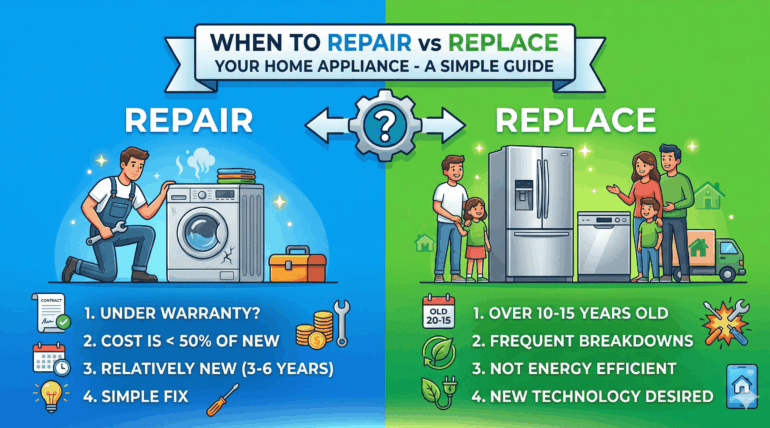
The core question: cost vs value
The repair vs replace decision comes down to one central question: is the cost of fixing the appliance worth it relative to what you’d gain from a new one? Two appliances may have the same repair cost, but the right answer can be completely different depending on age, energy efficiency, and availability of spare parts.
Lean towards repair when
- The appliance is less than half its expected lifespan
- Repair cost is less than 50% of replacement cost
- It’s a first-time breakdown with a clear single cause
- Spare parts are readily available
- The appliance is energy-efficient and modern
Lean towards replace when
- The appliance is old and breaking down repeatedly
- Repair cost exceeds 50% of a new appliance’s price
- Parts are obsolete or no longer manufactured
- Energy bills have increased noticeably
- Multiple components are failing at once
The 50% rule explained
The most widely used rule in appliance repair decisions is the 50% rule: if the repair cost exceeds 50% of what a comparable new appliance would cost, you’re better off replacing it. This rule protects you from throwing good money after bad — especially on older appliances that will likely need more repairs soon.
How to apply the 50% rule
Repair cost ÷ New appliance cost × 100 = Decision %
If the result is under 50% — repair. If it’s over 50% — seriously consider replacing. Factor in the appliance’s age: the older it is, the lower your threshold should be.
Example
Your washing machine compressor repair costs ₹6,500. A new equivalent model costs ₹18,000. That’s 36% — well under 50%, so repair makes financial sense. But if the machine is already 9 years old, think twice — more repairs may follow soon.
Appliance age — the most important factor
Every appliance has an expected lifespan. Once it crosses 75% of that lifespan, the repair-vs-replace calculation shifts firmly towards replacing — even if a single repair seems affordable. Here’s what to expect from common kitchen and home appliances.
| Appliance | Expected lifespan | Replace if older than |
| Refrigerator | 12–15 years | 10 years |
| Washing machine | 10–12 years | 8 years |
| Microwave oven | 7–10 years | 6 years |
| Dishwasher | 9–12 years | 8 years |
| Gas / electric oven | 13–15 years | 11 years |
| Air conditioner | 10–15 years | 10 years |
| Water heater / geyser | 8–12 years | 8 years |
Repair vs replace: quick decision guide
Answer these five questions before calling a technician or heading to the store. Each answer points you in a clear direction.
| Question | Yes → consider repair | No → consider replace |
| Is the appliance less than 75% through its expected lifespan | Good candidate for repair — still has useful life left | Replacement likely makes more long-term sense |
| Is the repair cost under 50% of a new appliance’s price? | Repair is financially sensible in most cases | You’re paying too much to extend a short remaining life |
| Is this the first or second breakdown of this appliance? | Likely an isolated fault — repair and monitor | Recurring failures suggest systemic deterioration |
| Are genuine spare parts still available for this model? | Repair is viable and quality can be maintained | Third-party parts reduce reliability — replace instead |
| Is the appliance energy-efficient by today’s standards? | Keeping it running saves on buying costs | A newer model could save significantly on electricity |
Final checklist before you decide
Run through this checklist the next time an appliance breaks down. It takes two minutes and could save you thousands.
- Get a written diagnosis and repair quote from a certified technician first.
- Apply the 50% rule — compare repair cost against a new appliance’s current market price.
- Check the appliance’s age against expected lifespan in the table above.
- Count how many times this appliance has broken down in the past 2 years.
- Check if genuine OEM spare parts are available for your model and brand.
- Consider energy savings — a new 5-star rated model may offset its cost in 2–3 years.
- Ask the technician honestly — a good service center will tell you when replacement is the better choice.
There’s no single right answer — but there is a smart framework. Use the 50% rule, factor in the appliance’s age and repair history, and always get a professional diagnosis before deciding. When in doubt, call a certified technician for an honest assessment — it costs far less than a premature replacement.


we denounce with righteous indignation and dislike men who are so beguiled and demoralized by the charms of pleasure of the moment.
Denounce with righteous indignation and dislike men who are so beguiled and demoralized by the charms of pleasure of the moment.